Certified Food Safety Professional (CFSP)


Key Information, Dates and Deadlines

Step into the spotlight as a Certified Food Safety Professional—no investment required, just your expertise!
TQCSI Arabia proudly offers leaders in the Arabian food industry a fully sponsored, 100% free online assessment and certification.
There’s absolutely no registration fee, no exam fee, and no certification fee—just a streamlined path to validate your mastery of Food Safety, Hazard Control Plans, ISO 22000:2018 FSMS, FSSC 22000 V6, BRCGS Food Safety Issue 9, and SQF & IFS Food Codes.
Training Brochure
To learn about the Certified Food Safety Professional (CFSP), click below to download the course brochure.
Confident in Your Food Safety Expertise?
Prove Through Our Online Assessment, and Earn the Industry's Most Prestigious Certification
The Certified Food Safety Professional (CFSP) program is a fully competency-based certification—no classroom attendance or instructor-led training is required. Simply satisfy the enrollment criteria outlined on the following pages, secure your unique digital assessment code, and complete the online examination. Achieve the minimum passing score, and you will be awarded the “Certified FOOd Safety professional” credential.

Achieve excellence in the certified food safety professional (CFSP) program—be among the top 10 scorers and eam not only your certificate but also an exclusive shield, distinguishing you as a recognized leader in food safety, both regionally and internationally.
Curriculum
Mastery Across 20 Domains
The Certified Food Safety Professional (CFSP) Program has been developed to offer an unparalleled, advanced level of expertise in food safety. This curriculum aligns with global standards such as the Codex Alimentarius General Principles of Food Hygiene, HACCP, ISO 22002: Parts 1 and 4, ISO 22000:2018, FSSC 22000, BRCGS Food Safety Issue 9 (GFSI-recognized schemes), and GCC Food Codes, among others.
The Certified Food Safety Professional (CFSP) assessment encompasses the following pivotal topics, concepts, and modules:
Fundamental Principles of Food Safety
Food Safety Hazards and Contamination Risks
Advanced Microbial Control and Pathogen Management
Hygienic Design and Sanitation Engineering
Cleaning, Sanitation, Waste Management, and Pest Control
Personal Hygiene and Employee Training
Packaging Safety and Material Integrity
Food Defense and Food Fraud Management
Food Safety Culture
Food Safety Controls in Feed and Farming
Food Safety Controls in Food Processing Operations
Food Safety Controls in Transport and Distribution
Food Safety Controls in Catering and Retail
Crisis Management and Food Recalls
Risk Assessment and Hazard Control Plan (HACCP)
Food Safety Legislation and Compliance
Advanced Crisis Communication and Risk Management
FSSC 22000 Version 6 and PRPs based on ISO 22002
BRCGS Food Safety Issue 9
SQF Food Codes Edition 9 and IFS Food Version 8

The Certified Food Safety Professional (CFSP) designation—aligned with GFSI-recognized FSMS frameworks such as FSSC 22000 and BRCGS Food Safety Issue 9, along with Gulf Food Authority standards and best practices—is the definitive credential for professionals dedicated to safeguarding the integrity of global food supply chains.
Developed by leading industry experts, the CFSP program seamlessly combines rigorous theoretical foundations with practical, real-world insights. It equips you to anticipate, prevent, and resolve complex food safety challenges with confidence and authority.
Sample Question
For Online Assessment
The Certified Food Safety Professional (CFSP) Program was meticulously designed by industry-leading experts with extensive hands-on experience. These professionals understand precisely which knowledge and skills are essential for today’s food safety practitioners.
Drawing on their collective expertise, the CFSP curriculum incorporates a diverse range of assessment formats to rigorously evaluate and validate the competence of participating candidates.
Which BRCGS Food Safety Issue 9 clause requires the site to maintain documented evidence of supplier approval and monitoring?
A. Clause 2.3
B. Clause 2.8
C. Clause 4.1.2
D. Clause 6.1.5Which of the following are requirements for validation of control measures?
A. Demonstrating reproducibility of the measure
B. Conducting verification only once at implementation
C. Using challenge tests or scientific data
D. Documenting acceptance criteriaAccording to BRCGS Food Safety Issue 9, how often must internal audits of the FSMS be conducted at a minimum?
A. Quarterly
B. Annually
C. Every two years
D. MonthlyWhich of the following are mandatory elements of a recall plan under both FSSC 22000 V6 and BRCGS Issue 9?
A. Traceability matrix
B. Media approval form
C. Communication procedure
D. Mock‑recall recordsAccording to FSSC 22000 V6, critical control points (CCPs) must be revalidated:
A. Whenever there is a change in equipment or process
B. Only when a customer complains
C. Never, once established D. Only during the annual management reviewWhich of the following pathogens are spore‑formers that can survive typical cooking temperatures?
A. Clostridium perfringens
B. Salmonella enterica
C. Bacillus cereus
D. Listeria monocytogenesWhat is the minimum incubation time and temperature for detecting Staphylococcus aureus in a food sample?
A. 24 h at 37 °C
B. 48 h at 25 °C
C. 18 h at 42 °C
D. 72 h at 30 °CSelect all that apply for Listeria monocytogenes:
A. Psychrotrophic (grows at refrigeration temperatures)
B. Strictly aerobic
C. Non‑spore‑forming
D. Commonly controlled by high acidificationWhich additive is commonly used to inhibit mould and some bacterial growth in cheese?
A. Sodium nitrite
B. Potassium sorbate
C. Monosodium glutamate
D. Calcium propionateWhich control measures are effective against anaerobic, spore‑forming Clostridium perfringens in meat products?
A. Rapid cooling through the danger zone (5–60 °C)
B. High‑pressure processing (HPP)
C. Extended room‑temperature storage
D. Addition of nitritesWhich food additive must be declared on the label if present at > 10 mg kg⁻¹ because of allergic reactions?
A. Sodium benzoate
B. Carmine (E120)
C. Monosodium glutamate
D. SulphitesAccording to GSO 9:2016 (General Standard for the Labelling of Pre‑packaged Foods), what minimum font height is required for the ingredient list on a small package (< 80 cm²)?
A. 1.2 mm
B. 0.9 mm
C. 0.5 mm
D. 0.3 mmWhich of the following shelf‑life studies complies with SFDA guidelines for determining expiry date?
A. Accelerated study at 45 °C for 15 days
B. Real‑time testing at storage temperature for 12 months
C. pH and water‑activity measurement only
D. Challenge test with inoculated pathogensUnder GSO 249:2018 (Microbiological Criteria for Foodstuffs), the maximum allowable total‑coliform count in pasteurised milk is:
A. 10 CFU mL⁻¹
B. 100 CFU mL⁻¹
C. 10² CFU mL⁻¹
D. 10³ CFU mL⁻¹Match each SFDA‑listed preservative with its maximum permitted level in bakery products (mg kg⁻¹):
Calcium propionate – Maximum level: 2,500 mg/kg
Sorbic acid – Maximum level: 1,000 mg/kg
Sodium benzoate – Maximum level: 1,000 mg/kg
Potassium sorbate – Maximum level: 1,000 mg/kg
Which design features help prevent microbial harborage in a food‑processing filling line?
A. Minimising dead‑leg piping
B. Welded 45° pipe joints
C. Open‑mesh conveyor belts
D. Sloped surfaces ≥ 3° for wash‑downIn sanitation engineering, what is the primary function of a CIP spray ball’s flow rate and coverage?
A. To cool equipment rapidly
B. To provide mechanical force to dislodge soils
C. To measure detergent concentration
D. To sterilise via steam injectionWhich cleaning‑validation parameter best indicates removal of biofilm from stainless‑steel surfaces?
A. Visual inspection under bright light
B. ATP bioluminescence readings
C. pH of final rinse water
D. Temperature of cleaning solutionWhich factor is most critical when selecting a sanitizer for equipment with high‑protein soils?
A. Low foaming
B. Broad UV‑light activation
C. High alkaline strength
D. Water‑hardness compatibilityA comprehensive HACCP verification programme includes:
A. Internal audits of PRPs and CCPs
B. Visual‑only checks of equipment cleanliness
C. Trend analysis of critical‑limit deviations
D. Re‑assessment after process or recipe changes
Comprehensive List of Eligible Roles
for Certified Food Safety Professional (CFSP) Online Certification
From "FARM TO FORK," any professional contributing to food safety can apply.
1. Primary Production & Agriculture
Farm Owner / Manager
Crop Production Supervisor
Agricultural Extension Officer
Livestock / Poultry Farm Supervisor
Fishery / Aquaculture Manager
Dairy Farm Manager
Beekeeping Manager
Pest Control Technician
2. Harvesting, Packing & Storage
Post-Harvest Handling Supervisor
Cold-Chain / Refrigeration Manager
Warehouse / Bulk Storage Manager
Packaging Line Supervisor
Grain Storage Supervisor
Silage / Forage Manager
3. Food Processing & Manufacturing
Production Manager
Quality Assurance (QA) Manager
Quality Control (QC) Supervisor
HACCP Coordinator / Team Leader
Food Safety Officer
Sanitation / Hygiene Supervisor
Process Engineer
Regulatory Affairs Specialist
R&D (Product Development) Scientist
Maintenance & Engineering Supervisor
4. Ingredients & Supply Chain Management
Procurement / Sourcing Manager
Supplier Quality Auditor
Supply Chain / Logistics Coordinator
Cold-Chain Logistics Manager
Import / Export Compliance Officer
5. Packaging, Labeling & Traceability
Packaging Development Specialist
Traceability / Recall Coordinator
Labeling / Regulatory Compliance Specialist
Materials / Packaging Engineer
6. Distribution & Retail
Distribution Center Manager
Retail Quality Manager
Supermarket / Grocery Chain QA Lead
Cold-Storage Transport Manager
Fleet Hygiene & Safety Supervisor
7. Foodservice & Hospitality
Restaurant / Kitchen Manager
Catering Operations Manager
Hotel Food Safety Manager
Institutional Foodservice Supervisor (e.g., hospitals, schools)
Beverage Safety Coordinator
8. Regulatory, Auditing & Certification
Food Safety Auditor / Lead Auditor
Third-Party Certification Body Assessor
Regulatory Inspector (Government / Local Authority)
Compliance Manager
9. Laboratory & Testing
Laboratory Manager
Microbiologist
Food Chemist
Analytical Testing Technician
Calibration Technician
10. Technical Support & Consulting
Food Safety Consultant
Technical Service Representative
Training & Development Specialist
EHS (Environmental, Health & Safety) Advisor
11. Corporate & Executive Leadership
Chief Food Safety Officer
Head of Quality & Compliance
Director of Food Safety & Regulatory Affairs
VP / SVP of Operations (Food Industry)
CEO / COO (Food Manufacturing or Processing Company)
12. Academia & Research
University Lecturer / Professor (Food Science, Nutrition)
Research Scientist (Food Safety & Preservation)
Extension Educator
Whether you’re hands-on in the field, leading a production line, or steering corporate strategy—if you play a role in the safety and integrity of food, the CFSP certification is designed for you.
Registration Eligibility Criteria
For Leaders Shaping the Future of Food Safety
This program is designed for professionals who play a pivotal role in food safety management, regulatory compliance, and crisis response within the food industry.
1. Nationality or Residency
Applicants must be nationals or residents of any Arab country, preferably from the GCC region.
2. Educational Qualification
A bachelor’s degree or higher in a science or engineering discipline, such as:
- Industrial, Mechanical or Chemical Engineering
- Food Science
- Biochemistry
- Medical Laboratory Sciences
- Public Health
- Agricultural Engineering
This ensures a strong theoretical foundation in microbiology, hazard analysis, and process control—key to effective food safety leadership.
3. Industry Experience
At least 2–5 years of hands-on experience in any part of the food value chain, including:
Farming
Dairy or food production
Pest control
Retail operations
Hospitality or food services
This confirms your practical understanding of real-world challenges, from farm-to-fork hygiene to supply chain risk management.
4. Language Proficiency
Fluency in English or Arabic is required.
All training and assessments are delivered exclusively in these languages. You must be able to interpret and apply technical standards like HACCP, ISO 22000, FSSC 22000, and BRCGS with ease.
5. Digital Literacy & Testing Readiness
Proficient in Microsoft Word, Excel, and PowerPoint for documentation and analysis
Familiarity with online testing platforms to ensure smooth participation in assessments
Enrollment Process
Transparent & Efficient
This program is designed for individuals who play a key role in food safety management, regulatory compliance, and crisis response within the food industry.
1. Access the Enrollment Portal
Navigate to the enrollment link using any modern web browser. Ensure a stable internet connection—our secure platform supports both desktop and mobile devices for your convenience.
2. Complete Your Application
Accurately fill in all required fields, including your highest academic qualification, detailed work experience in the food sector, and up-to-date contact information.
Be sure to double-check your entries for correct spelling and formatting (e.g., YYYY-MM-DD for dates) to prevent processing delays.
3. Credential Verification
Within 3 to 5 business days, the TQCSI Arabia Registration Team will verify your submitted credentials against Certified Food Safety Professional (CFSP) requirements.
You may be asked to provide clarifications or upload supporting documents. Keep digital copies of your degree certificates and employment records readily available.
4. Receive Your Unique Registration Code (URC)
Once approved, you will receive a Unique Registration Code (URC) via both email and SMS.
This code is your personal access key to the next stage. Store it securely.
5. Initiate Assessment Preparation
With your URC activated, log in to the assessment portal to access sample questions, the recommended reading list, and practice tools.
Set aside focused study time, monitor your readiness using the platform’s metrics, and prepare confidently for the Certified Food Safety Professional (CFSP) examination.
Delegate Responsibilities
Certified Food Safety Professional (CFSP)
1. Self-Study & Preparation
• Master the CFSP syllabus and reference materials—allocate 2–3 focused study hours daily (minimum 120 hours total) using the handbooks, practice tests, and recommended readings.
2. Technical Setup
• Use a dedicated desktop or laptop (no tablets) with a webcam, microphone, and a modern browser.
• Ensure a wired or stable Wi-Fi connection (minimum 25 Mbps) and uninterrupted power.
3. Pre-Exam System Check
• Log in 30–45 minutes early to run the auto-diagnostic (audio, video, network).
• Resolve any issues via on-screen prompts or contact candidate support.
4. Identity Verification
• Have a valid, government-issued photo ID on hand for on-camera authentication.
5. Secure Exam Environment
• Choose a quiet, well-lit, private room—post “Do Not Disturb” notices and eliminate all distractions.
6. Permitted Materials Only
• Use printed standards, codes, and guides only.
• Electronic files, notes, or extra devices are strictly prohibited.
7. Professional Conduct
• Remain in view at all times, no communication with others, and no unauthorized movement—any breach may lead to disqualification.
8. Time Management & Breaks
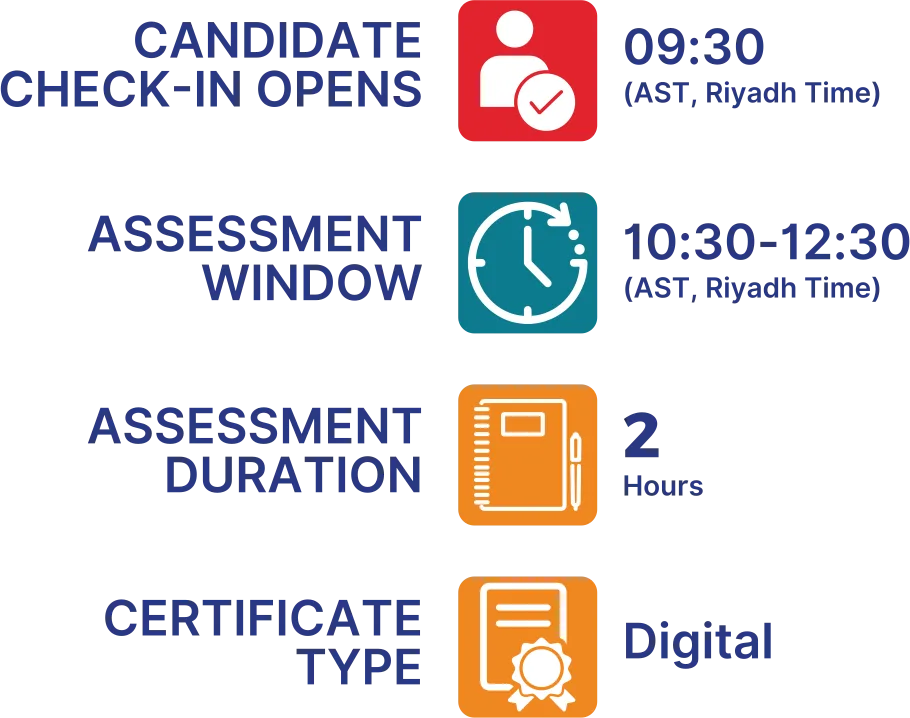
• Complete 80 questions in 2 hours; plan your pace accordingly.
• One 10-minute break is allowed (the timer will continue running).
9. Connectivity Contingency
• Click “Reconnect” immediately if disconnected.
• Contact support with timestamps if issues persist.
10. Submission & Results
• Review your answers, submit, and save your confirmation ID.
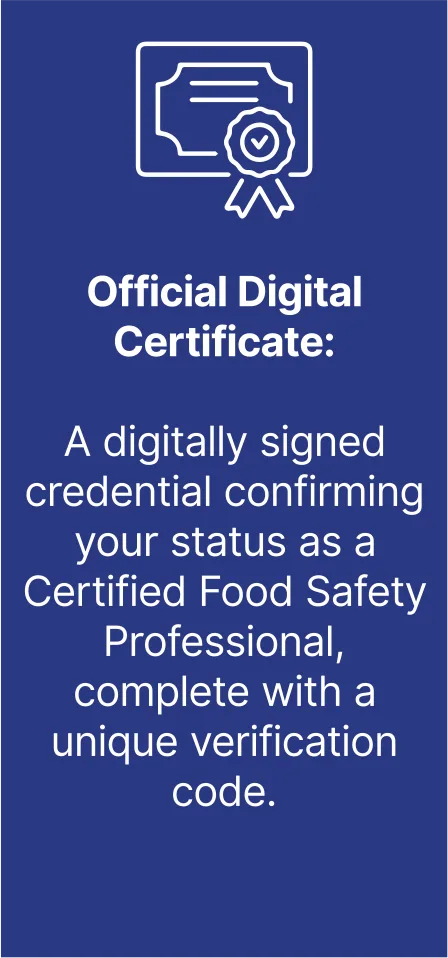
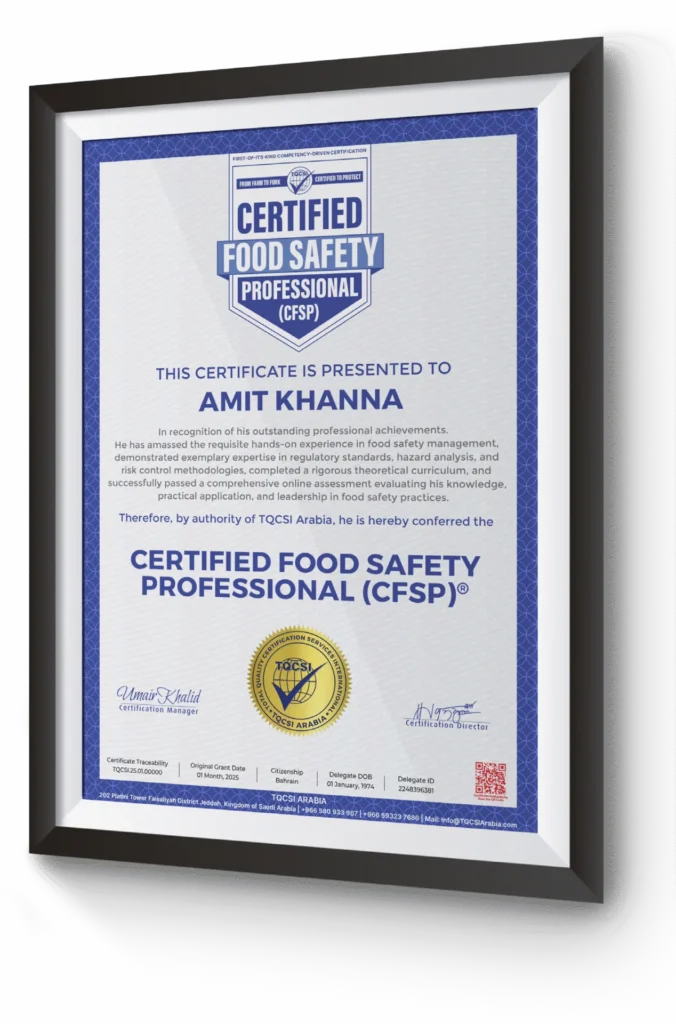
• Receive preliminary scores instantly and your official digital certificate within 72 hours.
• Two free retakes available within 12 months.
• Appeals must be filed within 48 hours.
Delegate Takeaways
Certified Food Safety Professional (CFSP)
Upon successful completion of the CFSP assessment, each delegate will receive a comprehensive package of credentials, resources, and ongoing benefits—all designed to maximize your return on investment and accelerate your career trajectory in the food safety industry.



Registration Form
Ready to Become a Certified Food Safety Professional?
Complete the form below to apply for the CFSP program. Provide your professional and educational details so we can assess your eligibility. Upon approval, you’ll receive your Unique Registration Code to access the assessment and begin your journey toward advanced food safety certification.
Get in Touch to Register
For further detail and registration, please call or Send personal detail to any of the below mentioned staff